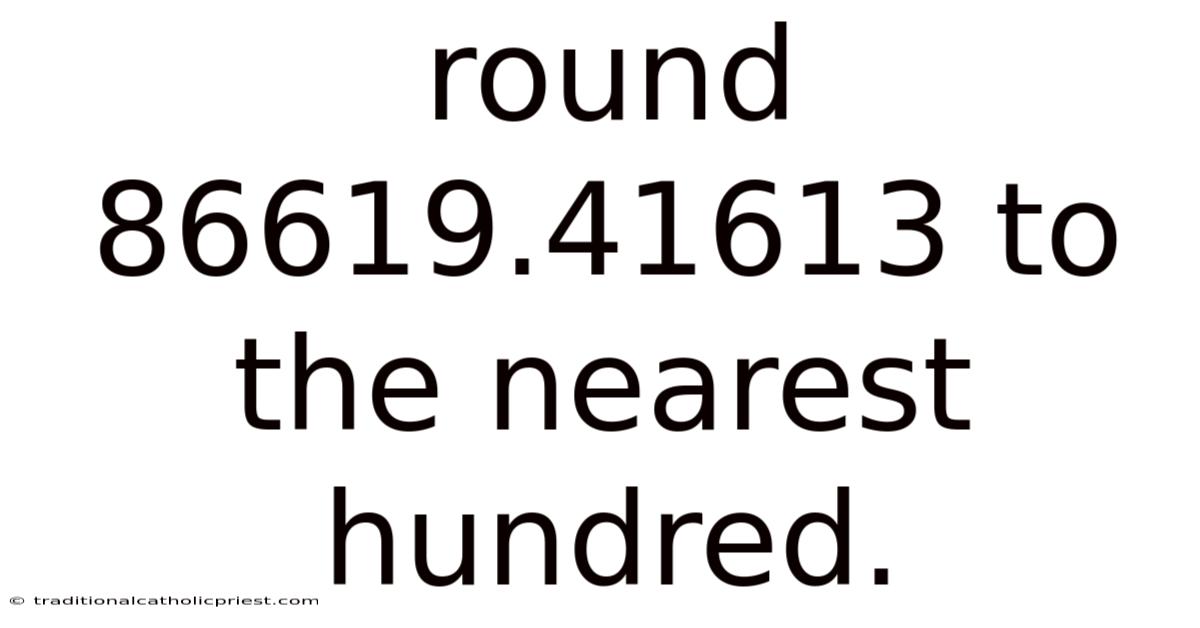
Have you ever found yourself staring at a number, wondering how to simplify it without losing its essence? Rounding numbers is a common mathematical practice that helps us do just that. Whether you're dealing with finances, measurements, or statistical data, knowing how to round numbers accurately is an invaluable skill.
Imagine you are a cashier, and a customer's total comes to $86619.Think about it: 41613. You wouldn't announce that exact amount, would you? So instead, you'd round it to a more manageable figure. But how do you decide what that figure should be? That said, in this article, we'll explore the ins and outs of rounding, specifically focusing on rounding the number 86619. In real terms, 41613 to the nearest hundred. Let's dive in and make sense of this essential mathematical concept.
Understanding Rounding to the Nearest Hundred
Rounding to the nearest hundred simplifies a number, making it easier to work with while keeping it close to its original value. In essence, it means adjusting the number so that the last two digits become zeros. It's a process that relies on identifying which hundred the number is closest to Small thing, real impact. Simple as that..
Not obvious, but once you see it — you'll see it everywhere Worth keeping that in mind..
When we talk about rounding, we're often dealing with two main types: rounding up and rounding down. Which means the number we want to round falls somewhere between two of these tick marks. So imagine a number line where each tick mark represents a hundred. Still, if it's closer to the higher hundred, we round up. The goal is to decide which of these two hundreds our number is closer to. If it's closer to the lower hundred, we round down.
The official docs gloss over this. That's a mistake Simple, but easy to overlook..
The concept of rounding to the nearest hundred is particularly useful in situations where precision isn't key but having a quick, easily understandable figure is. Here's one way to look at it: in business, you might round sales figures to the nearest hundred to provide a general overview without getting bogged down in exact amounts. Similarly, in statistical reports, rounding to the nearest hundred can make data easier to interpret and present Simple, but easy to overlook..
Rounding is also deeply rooted in our everyday lives. Consider budgeting, where you might round your expenses to the nearest hundred to get a clearer picture of your spending habits. Or think about estimating project costs, where rounding helps simplify calculations and manage expectations. This practice not only simplifies numbers but also aids in making informed decisions quickly.
Most guides skip this. Don't.
Before we get into the specific steps for rounding 86619.41613, let's delve deeper into the foundational principles that govern the world of rounding. These principles will give you a solid base, ensuring you can confidently tackle any rounding task that comes your way Which is the point..
Comprehensive Overview of Rounding Principles
To truly master rounding, understanding the principles that govern this process is crucial. These principles are the bedrock of accurate and effective rounding, applicable across various scenarios and number types Still holds up..
The Basic Rules of Rounding
The fundamental rule of rounding hinges on identifying the digit immediately to the right of the place value you're rounding to. In our case, since we're rounding to the nearest hundred, we'll focus on the tens digit. Here's the breakdown:
- If the tens digit is 0, 1, 2, 3, or 4, we round down. This means the hundreds digit remains the same, and all digits to the right of it become zero.
- If the tens digit is 5, 6, 7, 8, or 9, we round up. This means the hundreds digit increases by one, and all digits to the right of it become zero.
Here's one way to look at it: if we were rounding 1,249 to the nearest hundred, we'd look at the tens digit, which is 4. Since 4 is less than 5, we round down to 1,200. Conversely, if we were rounding 1,251 to the nearest hundred, we'd round up to 1,300 because the tens digit is 5.
Understanding Place Value
Place value is at the heart of rounding. Each digit in a number has a specific place value, such as ones, tens, hundreds, thousands, and so on. Recognizing these place values is essential for determining which digit to focus on when rounding That's the part that actually makes a difference..
In the number 86619.Plus, 4)
- 1 is in the hundredths place (0. 01)
- 6 is in the thousandths place (0.41613, the place values are as follows:
- 8 is in the ten-thousands place (80,000)
- 6 is in the thousands place (6,000)
- 6 is in the hundreds place (600)
- 1 is in the tens place (10)
- 9 is in the ones place (9)
- 4 is in the tenths place (0.On the flip side, 006)
- 1 is in the ten-thousandths place (0. 0001)
- 3 is in the hundred-thousandths place (0.
When rounding to the nearest hundred, we focus on the hundreds place and examine the tens digit to determine whether to round up or down.
The Significance of 5
The number 5 holds a important role in rounding conventions. It acts as the threshold that determines whether a number is rounded up or down. This convention ensures fairness and consistency in rounding practices.
Historically, the use of 5 as the midpoint is rooted in mathematical balance. It provides an equitable way to distribute rounding errors, ensuring that, over a large set of numbers, the total error introduced by rounding is minimized And that's really what it comes down to..
Rounding Decimals
Rounding decimals follows the same principles as rounding whole numbers. The only difference is that you're dealing with digits to the right of the decimal point. Even so, when rounding a decimal to the nearest whole number, you look at the tenths digit. If it's 5 or greater, you round up to the next whole number. If it's less than 5, you round down Still holds up..
To give you an idea, rounding 3.In practice, since 6 is greater than 5, we round up to 4. 6 to the nearest whole number involves looking at the tenths digit, which is 6. Day to day, conversely, rounding 3. 4 to the nearest whole number results in 3 because the tenths digit is less than 5 Most people skip this — try not to..
Practical Applications and Examples
Understanding these rounding principles isn't just theoretical; it has numerous practical applications:
- Financial Accounting: Companies often round financial figures to the nearest dollar or hundred dollars to simplify reports and focus on significant trends. Practically speaking, - Statistics: Rounding is used to present statistical data in an easily digestible format, making it simpler for audiences to understand complex information. That said, - Engineering: Engineers use rounding to account for tolerances and approximations in measurements and calculations. - Everyday Life: We use rounding daily when estimating costs, calculating tips, or managing budgets.
Now that we've covered the fundamental principles, let's apply these concepts to rounding the specific number 86619.41613 to the nearest hundred Easy to understand, harder to ignore..
Rounding 86619.41613 to the Nearest Hundred: A Step-by-Step Guide
Rounding 86619.41613 to the nearest hundred involves a straightforward process of identifying the relevant digits and applying the rounding rules. Here's a step-by-step guide to make it clear and simple:
- Identify the Hundreds Place: In the number 86619.41613, the digit in the hundreds place is 6. This represents 600.
- Look at the Tens Digit: The digit immediately to the right of the hundreds place is the tens digit, which is 1. This represents 10.
- Apply the Rounding Rule: Since the tens digit (1) is less than 5, we round down. This means the hundreds digit remains the same, and all digits to the right of it become zero.
- Round Down: That's why, 86619.41613 rounded to the nearest hundred is 86600.
Let’s illustrate with a few more examples to solidify the understanding:
- Example 1: Round 17852.75 to the nearest hundred.
- The hundreds digit is 5.
- The tens digit is 5.
- Since the tens digit is 5, we round up.
- Result: 17900
- Example 2: Round 23421.32 to the nearest hundred.
- The hundreds digit is 4.
- The tens digit is 2.
- Since the tens digit is less than 5, we round down.
- Result: 23400
- Example 3: Round 98765.43 to the nearest hundred.
- The hundreds digit is 7.
- The tens digit is 6.
- Since the tens digit is greater than 5, we round up.
- Result: 98800
Trends and Latest Developments in Rounding
While the basic principles of rounding remain constant, modern applications and computational tools have introduced some interesting trends and nuances. Here's a look at some of the latest developments:
The Use of Technology and Software
Today, rounding is often performed by computers and software, which can handle complex rounding scenarios quickly and accurately. Worth adding: spreadsheet programs like Microsoft Excel and Google Sheets have built-in rounding functions (e. g., ROUND, ROUNDUP, ROUNDDOWN) that allow users to specify the number of digits to round to and the direction of rounding. These tools also offer more advanced functions like significant figures rounding, which is commonly used in scientific contexts The details matter here..
Different Rounding Methods
While the standard rounding method (rounding half up) is the most common, there are other methods used in specific contexts:
- Rounding Half Down: In this method, numbers exactly halfway between two integers are rounded down.
- Rounding Half to Even: Also known as banker's rounding, this method rounds numbers to the nearest even number. This is used to reduce bias when dealing with large datasets, as it distributes rounding errors more evenly.
- Rounding Away From Zero: In this method, numbers are always rounded away from zero. As an example, -2.5 would be rounded to -3, and 2.5 would be rounded to 3.
The Impact of Big Data and Analytics
In the age of big data, rounding plays a critical role in data analysis and visualization. Because of that, large datasets often contain numbers with many decimal places, which can be cumbersome to work with. Plus, rounding these numbers to a more manageable format makes the data easier to interpret and present. Even so, it’s important to be aware of the potential impact of rounding on the accuracy of the analysis, especially when dealing with sensitive data.
Ethical Considerations
Rounding can sometimes raise ethical concerns, particularly in financial and statistical contexts. Here's one way to look at it: if rounding is used to manipulate financial results or statistical outcomes, it can lead to misrepresentation and deception. That's why, it’s essential to use rounding transparently and ethically, ensuring that it does not distort the underlying data or mislead stakeholders.
Tips and Expert Advice for Accurate Rounding
To ensure you're rounding numbers accurately and effectively, consider these tips and expert advice:
Always Identify the Correct Place Value
Before you start rounding, double-check that you've correctly identified the place value you're rounding to. This is the most common source of errors, so take your time and be precise. Here's one way to look at it: if you're rounding to the nearest thousand, make sure you're focusing on the thousands digit and not the hundreds or ten-thousands digit Which is the point..
Understand the Context
The context in which you're rounding can influence the appropriate level of precision. In some cases, you may need to round to the nearest whole number, while in others, you may need to round to the nearest tenth or hundredth. But consider the purpose of your rounding and choose the level of precision that best suits your needs. As an example, when dealing with financial transactions, you might need to round to the nearest cent, whereas, in scientific research, you might need to maintain several decimal places That alone is useful..
Use Rounding Functions in Software
If you're working with spreadsheets or other software, take advantage of the built-in rounding functions. These functions can automate the rounding process and reduce the risk of manual errors. Consider this: be sure to understand how the functions work and choose the appropriate rounding method for your situation. Most spreadsheet programs offer a variety of rounding functions, such as ROUND, ROUNDUP, ROUNDDOWN, and MROUND.
Be Consistent
Consistency is key when rounding numbers. On the flip side, choose a rounding method and stick to it throughout your calculations and reports. That's why this will help confirm that your results are accurate and reliable. Inconsistent rounding can lead to discrepancies and errors that can be difficult to track down Worth knowing..
Consider the Impact of Rounding on Accuracy
Rounding can introduce errors, especially when dealing with large datasets or complex calculations. Be aware of the potential impact of rounding on the accuracy of your results and take steps to minimize these errors. As an example, you might choose to perform calculations with more decimal places and round only at the final step.
People argue about this. Here's where I land on it.
Check Your Work
Always double-check your work to check that you haven't made any rounding errors. Here's the thing — this is especially important when dealing with critical data or calculations. Use a calculator or spreadsheet program to verify your results and catch any mistakes.
Document Your Rounding Methods
When presenting rounded numbers, be sure to document the rounding methods you used. Worth adding: this will help others understand how you arrived at your results and assess the potential impact of rounding on the accuracy of your conclusions. Transparency in rounding practices is essential for maintaining credibility and trust Worth knowing..
FAQ About Rounding
Q: What does it mean to round a number?
A: Rounding a number means approximating it to a nearby value that is often simpler or easier to work with. The goal is to simplify the number while keeping it reasonably close to its original value.
Q: Why do we round numbers?
A: We round numbers to simplify them, making them easier to understand, communicate, and use in calculations. Rounding is useful when exact precision is not necessary or when dealing with estimates It's one of those things that adds up..
Q: What's the difference between rounding up and rounding down?
A: Rounding up means increasing the digit in the specified place value by one, while rounding down means keeping the digit in the specified place value the same and setting all digits to the right to zero.
Q: How do I decide whether to round up or down?
A: Look at the digit immediately to the right of the place value you're rounding to. If that digit is 5 or greater, round up. If it's less than 5, round down.
Q: What is rounding to the nearest hundred?
A: Rounding to the nearest hundred means adjusting the number so that the last two digits become zeros. You determine whether to round up or down based on the value of the tens digit Easy to understand, harder to ignore..
Q: Can rounding significantly affect the accuracy of calculations?
A: Yes, especially when dealing with large datasets or complex calculations. Rounding errors can accumulate, leading to significant discrepancies in the final results. you'll want to be aware of this potential impact and take steps to minimize rounding errors.
Q: Are there different methods of rounding?
A: Yes, besides the standard rounding method (rounding half up), there are other methods such as rounding half down, rounding half to even (banker's rounding), and rounding away from zero Simple, but easy to overlook..
Conclusion
Rounding is a fundamental mathematical skill with broad applications in everyday life, business, science, and technology. Plus, 41613 to the nearest hundred, which resulted in 86600. In this article, we specifically addressed how to round the number 86619.We explored the basic principles of rounding, the significance of place value, and the role of the number 5 as the rounding threshold. We also discussed various rounding methods and the latest trends in rounding, including the use of technology and ethical considerations.
By understanding these principles and following the step-by-step guide, you can confidently round numbers to the nearest hundred or any other specified place value. Whether you're managing finances, analyzing data, or simply estimating costs, mastering the art of rounding will undoubtedly enhance your numerical literacy and decision-making skills.
Now that you have a solid grasp of rounding, put your knowledge into practice! Try rounding different numbers to various place values and see how it simplifies your calculations and enhances your understanding of numerical data. Don't hesitate to explore more advanced rounding techniques and tools to further refine your skills. Happy rounding!
This is where a lot of people lose the thread But it adds up..
