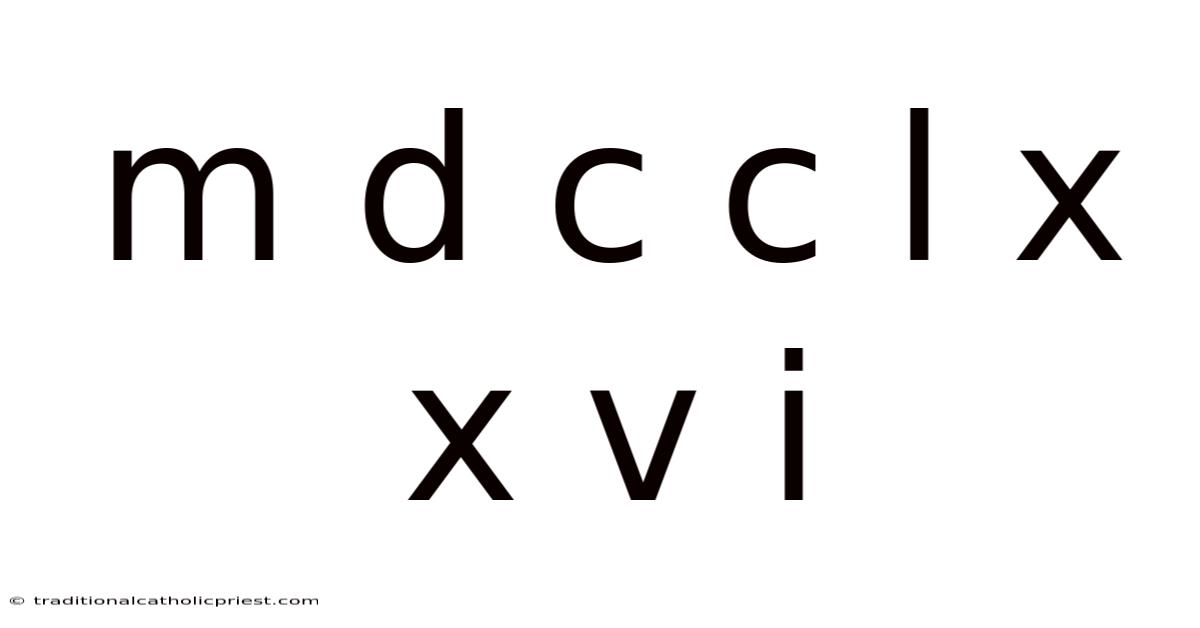
The glow of ancient Rome, with its complex numerals etched into monuments and scrolls, whispers stories of emperors, gladiators, and a civilization that shaped the world. But what happens when those ancient numerals appear today? Perhaps on a cornerstone, a movie title, or even as a cryptic message? Understanding how to decipher MDCCLXXVI—and other Roman numerals—opens a window into history and adds a unique dimension to our understanding of the world around us Nothing fancy..
The imposing figures and stoic emperors of Rome might seem distant from our modern world, yet the echoes of their civilization linger in unexpected places. Roman numerals, once the backbone of mathematical notation in Europe, continue to grace clock faces, book prefaces, and historical documents. Confronted with a string of these seemingly cryptic symbols, like MDCCLXXVI, many find themselves reaching for a conversion chart or an online tool. But with a little knowledge, unlocking the meaning behind Roman numerals becomes a straightforward and even enjoyable task, connecting us to centuries of tradition and intellectual heritage.
Unveiling MDCCLXXVI: A Journey Through Roman Numerals
To fully appreciate the elegance and simplicity of the Roman numeral system, it's helpful to understand its context. Unlike the positional notation of Arabic numerals (0-9), where the position of a digit determines its value, Roman numerals use a fixed set of symbols to represent specific quantities. These symbols are then combined additively and subtractively to form larger numbers Small thing, real impact..
Honestly, this part trips people up more than it should.
The Foundations of Roman Numerals
The Roman numeral system is based on seven primary symbols:
- I = 1
- V = 5
- X = 10
- L = 50
- C = 100
- D = 500
- M = 1000
These symbols, believed to have originated from tally marks used by early civilizations, were ingeniously adapted by the Romans to create a system capable of representing a wide range of numbers. The beauty of this system lies in its simplicity and its direct representation of quantity, making it easily understandable in practical contexts like trade and record-keeping Less friction, more output..
This changes depending on context. Keep that in mind.
Decoding MDCCLXXVI: A Step-by-Step Approach
Now, let's break down the Roman numeral MDCCLXXVI to reveal its numerical value. We'll proceed from left to right, adding the values of each symbol while considering the subtractive principle where a smaller numeral precedes a larger one:
- M = 1000
- D = 500
- C = 100
- C = 100
- L = 50
- X = 10
- X = 10
- V = 5
- I = 1
Adding these values together: 1000 + 500 + 100 + 100 + 50 + 10 + 10 + 5 + 1 = 1776
So, MDCCLXXVI represents the number 1776. A significant year in history, most notably marking the signing of the Declaration of Independence of the United States Most people skip this — try not to..
The Additive and Subtractive Principles
So, the Roman numeral system operates on two fundamental principles: addition and subtraction.
- Additive Principle: When a symbol of lesser or equal value follows a symbol of greater value, their values are added. Take this: VI = 5 + 1 = 6, and XI = 10 + 1 = 11.
- Subtractive Principle: When a symbol of lesser value precedes a symbol of greater value, the lesser value is subtracted from the greater value. This rule has some limitations:
- Only I, X, and C can be used as subtractive numerals.
- I can only precede V and X (e.g., IV = 4, IX = 9).
- X can only precede L and C (e.g., XL = 40, XC = 90).
- C can only precede D and M (e.g., CD = 400, CM = 900).
Understanding these principles is crucial for accurately interpreting and converting Roman numerals. Without them, it's easy to misinterpret the value of a numeral or construct an invalid representation No workaround needed..
Common Mistakes and How to Avoid Them
Working with Roman numerals can sometimes lead to errors, particularly for those unfamiliar with the system. Here are some common mistakes to watch out for:
- Incorrect Subtraction: Applying the subtractive principle incorrectly is a frequent error. Remember that only I, X, and C can be used for subtraction, and they can only precede specific numerals. Take this: writing "IC" for 99 is incorrect; the correct form is "XCIX."
- Repeating Numerals Too Many Times: A numeral should not be repeated more than three times consecutively. To give you an idea, 40 should be written as "XL," not "XXXX."
- Ignoring the Order: The order of numerals is critical. Changing the order can drastically alter the value. "VI" is 6, while "IV" is 4.
- Using Invalid Combinations: Some combinations of numerals are simply not allowed. As an example, "VX" is not a valid way to represent 5.
By being mindful of these potential pitfalls and double-checking your work, you can significantly reduce the likelihood of making errors when working with Roman numerals.
The Enduring Legacy of Roman Numerals
Despite the widespread adoption of Arabic numerals, Roman numerals continue to hold a prominent place in our culture. Their enduring presence is a testament to their historical significance and their aesthetic appeal. You'll find them used for:
- Clock Faces: Many traditional clocks and watches use Roman numerals to mark the hours, lending a touch of classic elegance.
- Book Chapters and Prefaces: Publishers often use Roman numerals to number the preliminary pages or chapters of a book.
- Movie Credits and Titles: Roman numerals are frequently used to indicate sequels or to add a sense of historical gravitas to a film's title.
- Cornerstones and Monuments: Architects and builders often inscribe dates in Roman numerals on cornerstones and monuments, preserving the date of construction for posterity.
- Outlines and Lists: In academic writing and formal outlines, Roman numerals are often used to denote the main sections or points.
Trends and Latest Developments
While the fundamental principles of Roman numerals remain unchanged, their usage and perception continue to evolve. There's a growing appreciation for their aesthetic qualities and their connection to history.
The Resurgence of Roman Numerals in Design
In recent years, we've seen a resurgence of Roman numerals in design, particularly in areas like:
- Typography: Designers are incorporating Roman numerals into fonts and logos to create a sense of sophistication and tradition.
- Tattoos: Roman numeral tattoos are a popular way to commemorate significant dates or events in a personal and visually appealing manner.
- Jewelry: Roman numerals are being used in jewelry design to create personalized and meaningful pieces.
- Home Decor: From wall art to clocks, Roman numerals are finding their way into home decor, adding a touch of historical charm.
This trend reflects a broader cultural interest in history, craftsmanship, and timeless design. Roman numerals offer a way to connect with the past while adding a unique and stylish element to contemporary designs Practical, not theoretical..
Digital Tools and Roman Numeral Conversion
Despite the renewed interest in Roman numerals, many people still rely on digital tools for conversion. Numerous online converters and calculators can quickly and accurately translate between Roman numerals and Arabic numerals. These tools are particularly useful for those who encounter Roman numerals infrequently or need to work with large numbers.
Even so, don't forget to remember that these tools should be used as aids, not replacements for understanding the underlying principles of the system. By learning the basics of Roman numerals, you can develop a deeper appreciation for their history and their enduring appeal.
Tips and Expert Advice
Mastering Roman numerals is a rewarding endeavor that can enhance your understanding of history, mathematics, and design. Here are some practical tips and expert advice to help you on your journey:
Start with the Basics
Before diving into complex conversions, make sure you have a solid grasp of the fundamental symbols and principles. In practice, memorize the values of the seven basic numerals (I, V, X, L, C, D, M) and understand the additive and subtractive rules. Practice converting simple numbers until you feel confident.
Real talk — this step gets skipped all the time.
Break Down Complex Numerals
When faced with a long or complex Roman numeral, break it down into smaller, more manageable parts. Plus, identify the individual symbols and their values, then apply the additive and subtractive principles step by step. This approach will make the conversion process much easier and less prone to errors And it works..
Use a Reference Chart
Keep a reference chart of Roman numerals handy, especially when you're just starting. On the flip side, this will help you quickly look up the values of unfamiliar symbols and combinations. You can find numerous reference charts online or create your own.
Practice Regularly
Like any skill, mastering Roman numerals requires practice. In practice, try converting numbers you encounter in everyday life, such as dates, addresses, or page numbers. The more you practice, the more comfortable and confident you'll become.
Seek Out Resources
There are many excellent resources available for learning about Roman numerals, including books, websites, and online courses. Explore these resources to deepen your knowledge and discover new insights.
Understand the Historical Context
Learning about the history of Roman numerals can add another layer of appreciation to your understanding. Research the origins of the system, its evolution over time, and its role in Roman society. This historical context will make the numerals more meaningful and memorable.
Honestly, this part trips people up more than it should.
FAQ
Q: What is the largest number that can be represented with Roman numerals?
A: In theory, there is no limit. On the flip side, the standard Roman numeral system traditionally used M (1000) as the largest single symbol. To represent larger numbers, a bar (vinculum) was placed above a numeral to multiply it by 1000. And for example, V with a bar above it would represent 5,000. In modern usage, it is generally accepted that the largest number easily represented without modification is 3,999 (MMMCMXCIX).
Q: Can Roman numerals be used for fractions?
A: Yes, the Romans did have a system for representing fractions, although it was not as sophisticated as our modern decimal system. The most common fractional unit was the uncia, which represented 1/12. Symbols were used to represent multiples of the uncia, such as the semis (1/2) represented by "S" Took long enough..
Q: Why are Roman numerals still used today?
A: Roman numerals are used today primarily for aesthetic, historical, and traditional reasons. In real terms, they add a touch of elegance to clock faces, book prefaces, and other applications. They also serve as a reminder of the Roman Empire's lasting influence on Western civilization Worth keeping that in mind..
Q: Is there a difference between uppercase and lowercase Roman numerals?
A: While both uppercase and lowercase Roman numerals are valid, uppercase is more commonly used, especially in formal contexts. Lowercase Roman numerals are sometimes used in book prefaces or other situations where a more subtle or understated appearance is desired And that's really what it comes down to..
Q: Are there different variations of Roman numerals?
A: Yes, there have been some variations in the way Roman numerals have been written throughout history. Still, for example, the subtractive principle was not always consistently applied, and some numerals were written in different forms. Even so, the standard system described in this article is the most widely accepted and used today.
The official docs gloss over this. That's a mistake Not complicated — just consistent..
Conclusion
MDCCLXXVI, now unveiled as the year 1776, serves as a potent reminder that even ancient systems of notation can hold contemporary relevance. From clock faces to historical documents, Roman numerals continue to subtly weave themselves into the fabric of our modern world. Understanding their principles not only demystifies these symbols but also provides a tangible connection to a civilization that profoundly shaped Western culture.
We encourage you to continue exploring the fascinating world of Roman numerals. Test your knowledge by converting dates, deciphering inscriptions, and perhaps even incorporating these timeless symbols into your own creative projects. Still, share your newfound understanding with others and help keep the legacy of Roman numerals alive. What other historical symbols intrigue you? Let us know in the comments below and inspire future explorations into the past Worth knowing..
