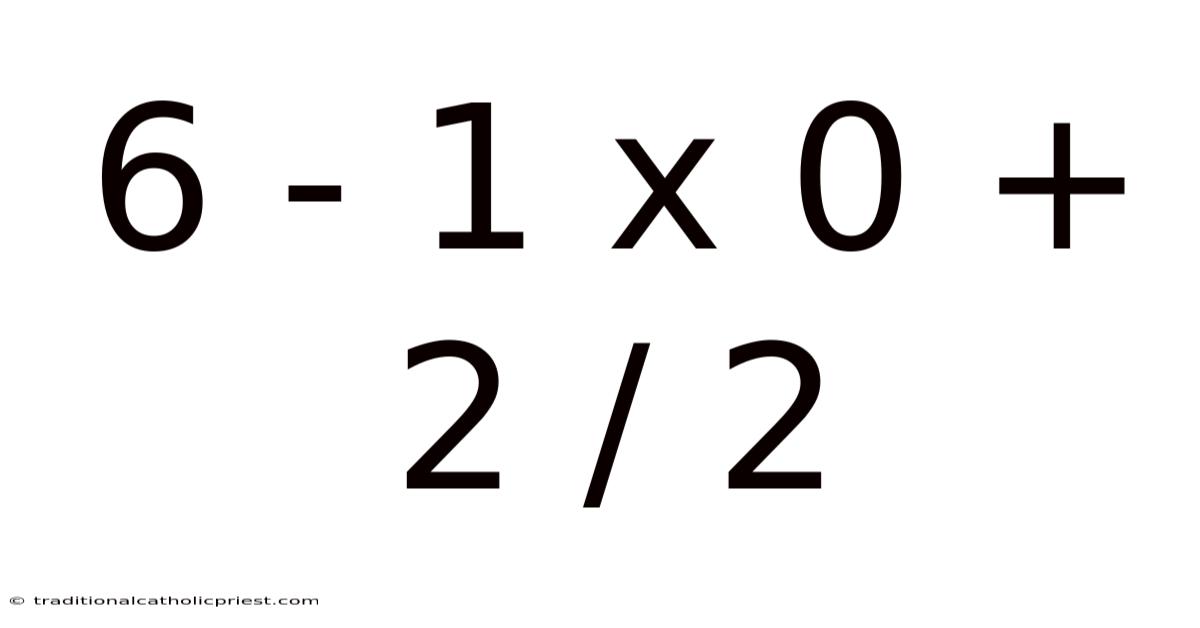
Have you ever stumbled upon a math problem that looks deceptively simple but sparks heated debates online? Which means the expression 6 - 1 x 0 + 2 / 2 is one such puzzle. It seems straightforward, yet it often leads to different answers depending on how people approach it. This seemingly innocent string of numbers and operators has become a viral sensation, highlighting the importance of understanding the order of operations in mathematics.
The beauty of math lies in its precision and universal rules. That said, without a clear understanding of these rules, simple expressions can become sources of confusion and disagreement. Which means this particular problem, 6 - 1 x 0 + 2 / 2, perfectly illustrates this point. People from various backgrounds, educational levels, and even professions have weighed in, often arriving at different conclusions. This article will walk through the correct way to solve this problem, explore the underlying mathematical principles, and discuss why such expressions often lead to widespread debate.
The Correct Approach: Understanding Order of Operations
To correctly solve 6 - 1 x 0 + 2 / 2, it's crucial to understand and apply the order of operations, often remembered by the acronym PEMDAS or BODMAS. These acronyms provide a hierarchy that dictates the sequence in which mathematical operations must be performed.
PEMDAS stands for:
- Parentheses
- Exponents
- Multiplication and Division (from left to right)
- Addition and Subtraction (from left to right)
BODMAS stands for:
- Brackets
- Orders
- Division and Multiplication (from left to right)
- Addition and Subtraction (from left to right)
Both PEMDAS and BODMAS represent the same fundamental principle: certain operations take precedence over others. Ignoring this order can lead to incorrect answers, as demonstrated by the varying solutions people often propose for our problem.
A Comprehensive Overview of the Mathematical Principles
The order of operations isn't an arbitrary convention; it's a fundamental aspect of mathematical notation that ensures consistency and clarity. Without a standardized order, mathematical expressions would be ambiguous, and communication of mathematical ideas would be nearly impossible. To fully grasp the significance of PEMDAS/BODMAS, let's delve deeper into its components and rationale.
-
Parentheses/Brackets: These are used to group operations, indicating that the operations within them should be performed before any others. They essentially override the standard order, allowing us to specify the sequence of calculations. As an example, in the expression 2 x (3 + 4), we first add 3 and 4, then multiply the result by 2.
-
Exponents/Orders: Exponents represent repeated multiplication (e.g., 2^3 = 2 x 2 x 2). They take precedence over multiplication, division, addition, and subtraction because they represent a more fundamental mathematical operation Which is the point..
-
Multiplication and Division: These operations are performed from left to right. They have equal precedence, meaning that if both appear in an expression, you perform whichever comes first as you read from left to right. This left-to-right rule is crucial for maintaining consistency in calculations Less friction, more output..
-
Addition and Subtraction: Similar to multiplication and division, addition and subtraction are performed from left to right and have equal precedence. This ensures that expressions are evaluated consistently, regardless of the order in which these operations appear.
The order of operations has evolved over centuries as mathematical notation has become more standardized. Early mathematical texts often lacked clear conventions, leading to ambiguity and misinterpretations. Worth adding: as algebra and other branches of mathematics developed, the need for a consistent and unambiguous order became increasingly apparent. Mathematicians gradually adopted the conventions we use today, ensuring that mathematical expressions have a single, correct interpretation.
Worth pausing on this one.
The beauty of this system lies in its ability to handle complex equations with multiple operations in a clear and concise manner. In practice, by adhering to PEMDAS/BODMAS, mathematicians, scientists, and engineers can communicate mathematical ideas effectively and avoid errors in calculations. Without this system, even simple calculations could lead to chaos and inconsistency.
Solving 6 - 1 x 0 + 2 / 2 Step-by-Step
Now, let's apply the order of operations to solve 6 - 1 x 0 + 2 / 2 correctly:
- Multiplication: 1 x 0 = 0. The expression becomes: 6 - 0 + 2 / 2
- Division: 2 / 2 = 1. The expression becomes: 6 - 0 + 1
- Subtraction: 6 - 0 = 6. The expression becomes: 6 + 1
- Addition: 6 + 1 = 7
Because of this, the correct answer to 6 - 1 x 0 + 2 / 2 is 7.
Many people incorrectly arrive at different answers because they overlook the order of operations, especially the precedence of multiplication and division over addition and subtraction. As an example, some might perform the subtraction 6 - 1 first, leading to an incorrect result Small thing, real impact..
Trends and Latest Developments in Mathematical Education
In recent years, there has been a renewed emphasis on mathematical literacy and problem-solving skills in education. Because of that, traditional approaches that focused solely on memorization and rote learning are gradually being replaced by methods that stress conceptual understanding and critical thinking. This shift is driven by the recognition that mathematics is not just a set of rules and formulas but a powerful tool for understanding and solving real-world problems Less friction, more output..
One notable trend is the use of visual aids and interactive tools to help students grasp mathematical concepts. Practically speaking, these tools can make abstract ideas more concrete and engaging, fostering a deeper understanding of the underlying principles. Here's one way to look at it: online simulations and interactive games can help students visualize the order of operations and explore how different operations affect the outcome of an expression Surprisingly effective..
Another important development is the integration of technology into mathematics education. Software and apps are now available that can assist students with calculations, graphing, and problem-solving. These tools can free up students to focus on higher-level thinking and conceptual understanding, rather than getting bogged down in tedious calculations.
On top of that, there is a growing emphasis on collaborative learning and problem-solving in mathematics classrooms. In real terms, students are encouraged to work together to solve problems, discuss their reasoning, and learn from each other. This approach can help students develop critical thinking, communication, and teamwork skills, which are essential for success in the 21st century.
The debate surrounding problems like 6 - 1 x 0 + 2 / 2 has also highlighted the importance of clear and consistent communication in mathematics education. Educators are increasingly emphasizing the need for students to explain their reasoning and justify their answers, rather than simply providing a numerical result. This helps students develop a deeper understanding of the underlying concepts and avoid common mistakes.
Tips and Expert Advice for Mastering Order of Operations
Mastering the order of operations is essential for anyone who wants to succeed in mathematics and related fields. Here are some practical tips and expert advice to help you improve your understanding and avoid common mistakes:
- Memorize PEMDAS/BODMAS: While memorization alone is not sufficient, it provides a solid foundation for understanding the order of operations. Regularly reviewing the acronym can help you internalize the hierarchy of operations.
- Practice Regularly: The more you practice solving problems that involve multiple operations, the more comfortable you will become with applying the order of operations. Start with simple expressions and gradually work your way up to more complex problems.
- Use Parentheses Strategically: When in doubt, use parentheses to clarify the order in which you want operations to be performed. This can help you avoid ambiguity and make sure you arrive at the correct answer.
- Break Down Complex Expressions: When faced with a complex expression, break it down into smaller, more manageable steps. This can help you avoid making mistakes and make sure you apply the order of operations correctly.
- Check Your Work: Always double-check your work to confirm that you have applied the order of operations correctly and that you have not made any arithmetic errors. Use a calculator or online tool to verify your answer.
- Understand the Underlying Concepts: Don't just memorize the rules; strive to understand the underlying concepts. Why do exponents take precedence over multiplication? Why is it important to perform multiplication and division from left to right? A deeper understanding will help you apply the order of operations more effectively.
- Seek Help When Needed: If you are struggling to understand the order of operations, don't hesitate to seek help from a teacher, tutor, or online resource. There are many excellent resources available that can help you improve your understanding and skills.
By following these tips and expert advice, you can master the order of operations and avoid common mistakes. This will not only improve your performance in mathematics but also enhance your critical thinking and problem-solving skills in other areas of life.
This is where a lot of people lose the thread.
FAQ: Frequently Asked Questions About Order of Operations
-
Q: What happens if I perform addition before multiplication?
A: If you perform addition before multiplication, you will likely arrive at an incorrect answer. In practice, the order of operations dictates that multiplication and division take precedence over addition and subtraction. * **Q: Does it matter if I use PEMDAS or BODMAS?
A: No, it does not matter. PEMDAS and BODMAS are simply different acronyms that represent the same order of operations. The underlying principles are the same No workaround needed..
-
**Q: What if an expression only contains addition and subtraction?
A: If an expression only contains addition and subtraction, you perform the operations from left to right.
-
Q: Are there any exceptions to the order of operations?
A: While the order of operations is generally consistent, there may be some exceptions in specific contexts or with certain mathematical notations. Still, for most common mathematical expressions, PEMDAS/BODMAS applies.
-
**Q: How important is it to understand the order of operations?
A: Understanding the order of operations is crucial for anyone who wants to succeed in mathematics and related fields. It is a fundamental concept that underpins many mathematical calculations and problem-solving techniques.
Conclusion
The expression 6 - 1 x 0 + 2 / 2 serves as a powerful reminder of the importance of understanding and applying the order of operations in mathematics. Now, while it may seem like a simple problem, it highlights how easily confusion can arise without a clear understanding of PEMDAS/BODMAS. By mastering the order of operations, we can confirm that our calculations are accurate and consistent, and we can communicate mathematical ideas effectively That's the part that actually makes a difference..
Now that you understand the correct way to solve 6 - 1 x 0 + 2 / 2, why not share this article with your friends and family and see if they can solve it correctly? Encourage them to explore the fascinating world of mathematics and discover the beauty of its precision and logic. Engage in discussions about mathematical concepts, challenge each other with interesting problems, and encourage a love for learning Which is the point..
