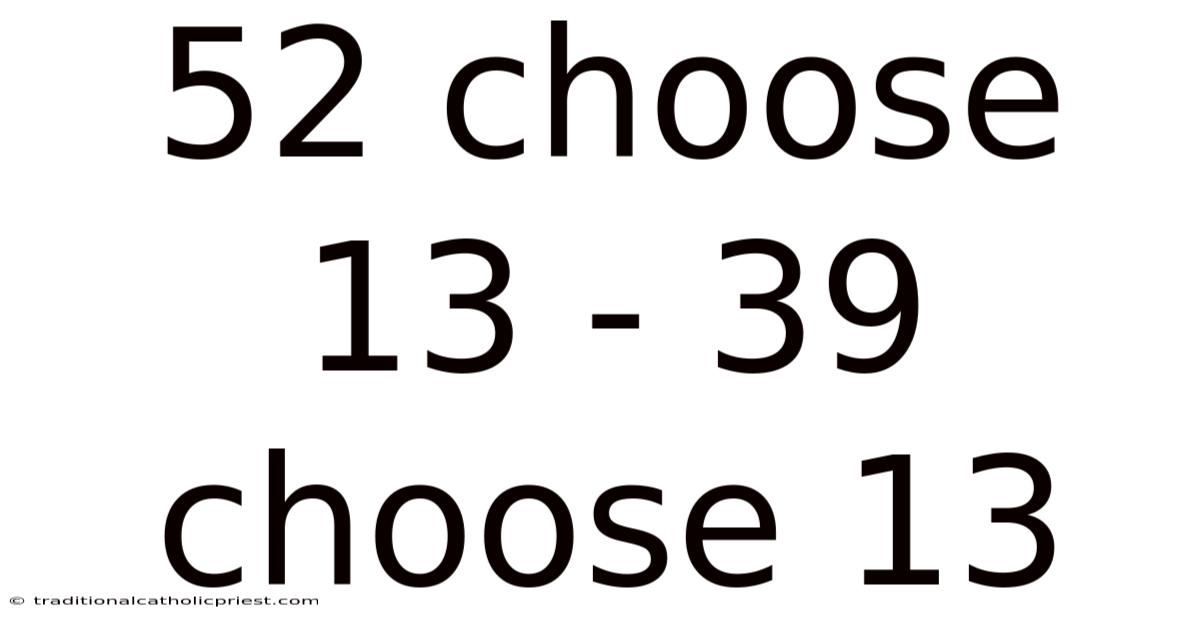
Imagine standing before a vast collection of unique possibilities. Now, imagine you have to pick a subset of these possibilities, and then from the remaining items, you have to make another selection. Day to day, this is precisely the scenario the equation "52 choose 13 - 39 choose 13" presents. At first glance, it may seem like a simple combinatorial problem, but beneath the surface lies a fascinating exploration of choices, probabilities, and mathematical principles.
Diving into the world of combinations unveils how we quantify the number of ways to select items from a larger set without regard to order. The formula n choose k, often written as C(n, k) or (<sup>n</sup><sub>k</sub>), represents the number of ways to choose k items from a set of n items. Applying this to the expression "52 choose 13 - 39 choose 13," we're essentially looking at the difference between two such combinatorial calculations. But what does this difference signify in practical terms? In this comprehensive exploration, we will look at the depths of this equation, uncover its mathematical underpinnings, and examine its applications in various fields, including probability and statistics.
And yeah — that's actually more nuanced than it sounds Worth keeping that in mind..
Main Subheading
Combinatorial mathematics is a branch of mathematics that deals with counting, arrangement, and combination of objects. At its core, it addresses how to count the number of ways specific events can occur. The expression "52 choose 13 - 39 choose 13" falls squarely into this domain. This involves the use of combinations, which are selections of items from a larger set where the order of selection does not matter. To understand the expression, we must first grasp the basics of combinations and how they are calculated.
The notation n choose k (often written as C(n, k) or (<sup>n</sup><sub>k</sub>)) represents the number of ways to choose k elements from a set of n distinct elements without regard to order. The formula to calculate this is:
C(n, k) = n! / (k!(n-k)!)
Here, n! (n factorial) is the product of all positive integers up to n. Take this: 5! = 5 × 4 × 3 × 2 × 1 = 120. Because of that, the factorial function grows very rapidly, which makes combinatorial calculations quickly grow into large numbers. Understanding this formula is critical for evaluating the expression "52 choose 13 - 39 choose 13.
Comprehensive Overview
The expression "52 choose 13 - 39 choose 13" embodies a specific comparative relationship between two combinatorial scenarios. Let's break down each component to fully understand its significance Less friction, more output..
First, let's address "52 choose 13," which can be mathematically written as C(52, 13). Practically speaking, this represents the number of ways to choose 13 items from a set of 52 distinct items. A classic example of this is drawing 13 cards from a standard deck of 52 playing cards.
C(52, 13) = 52! / (13! * 39!)
This number is quite large, approximately 635 billion. It represents the sheer number of different 13-card hands you could potentially draw from a standard deck.
Next, consider "39 choose 13," or C(39, 13). This signifies the number of ways to select 13 items from a set of 39. Mathematically, this is:
C(39, 13) = 39! / (13! * 26!)
This yields a number of approximately 8.12 billion, also a substantial figure, but significantly smaller than C(52, 13). This number represents how many different 13-item subsets can be formed from a set of 39 items.
The subtraction, "52 choose 13 - 39 choose 13," then gives us the difference between these two quantities. This difference tells us how many more ways there are to choose 13 items from a set of 52 compared to choosing 13 items from a set of 39. The result is approximately 627 billion, a figure that underscores the significant impact of the initial set size on the number of possible combinations.
In more intuitive terms, let’s consider a practical example. Imagine you have 52 different books, and you want to select 13 to donate to a library. So c(52, 13) represents the total number of different sets of 13 books you could choose. Now, suppose you remove 13 of those books, leaving you with 39. C(39, 13) represents the total number of different sets of 13 books you could choose from this smaller collection. The difference between these two numbers tells you how many more options you had when you started with the larger collection of 52 books.
From a probability perspective, this expression is relevant in scenarios where you’re calculating the probability of certain events involving selections from different sized pools. Take this case: if you are calculating the probability of drawing a specific hand in a card game, the number of possible hands (combinations) directly impacts the probability calculation That alone is useful..
The substantial difference between C(52, 13) and C(39, 13) highlights an important principle in combinatorics: as the size of the initial set (n) increases, the number of possible combinations grows exponentially. This has implications in various fields, including computer science, where algorithms dealing with large datasets must efficiently manage the combinatorial explosion of possibilities.
This changes depending on context. Keep that in mind.
What's more, this concept can be generalized. If we consider C(n, k) - C(n-x, k), this would represent the difference in combinations when selecting k items from a set of n compared to selecting k items from a set of n-x. The larger x is, the greater the difference, illustrating the sensitivity of combinations to the size of the original set. This has significant implications in areas like experimental design, where the size of the sample space can greatly affect the potential outcomes and statistical power of a study.
Trends and Latest Developments
In recent years, combinatorial mathematics has seen significant advancements, largely driven by the increasing computational power available. So modern trends involve leveraging algorithms and computational tools to tackle complex combinatorial problems that were previously intractable. These developments have impacted fields ranging from cryptography to network analysis.
One notable trend is the use of computational methods to approximate combinatorial quantities. But exact calculations of combinations involving very large numbers are often computationally prohibitive. So approximation algorithms, such as Monte Carlo methods, are employed to estimate these quantities with reasonable accuracy. These methods are particularly useful in statistical mechanics and machine learning.
Another area of development is the application of combinatorial designs in coding theory. That said, combinatorial designs, such as Latin squares and balanced incomplete block designs, are used to construct efficient error-correcting codes. These codes are crucial for reliable data transmission in noisy environments, such as wireless communication and data storage Surprisingly effective..
Worth pausing on this one.
Adding to this, the study of combinatorial structures is increasingly intertwined with network science. Analyzing networks, whether they are social networks, biological networks, or computer networks, often involves counting and characterizing different types of subgraphs or motifs. These combinatorial analyses can reveal important properties of the network, such as its resilience to failures or the presence of communities.
Data science and machine learning also rely heavily on combinatorial principles. Feature selection, for example, involves choosing a subset of relevant features from a larger set. This is essentially a combinatorial problem, where the goal is to find the combination of features that maximizes predictive accuracy. Similarly, clustering algorithms often use combinatorial optimization techniques to group similar data points together Small thing, real impact..
Most guides skip this. Don't.
Recent professional insights also highlight the importance of combinatorial thinking in problem-solving across various domains. This leads to understanding combinatorial principles can help in designing efficient algorithms, optimizing resource allocation, and making informed decisions in complex situations. As an example, in supply chain management, combinatorial optimization techniques are used to minimize transportation costs and inventory levels. In healthcare, they can be used to optimize the scheduling of surgeries and allocate resources efficiently during a pandemic Simple, but easy to overlook..
The expression "52 choose 13 - 39 choose 13" serves as a tangible example of how combinatorial calculations can provide valuable insights. Understanding the magnitude of these numbers and the differences between them allows professionals to appreciate the complexities involved in making choices and the impact of the initial set size on the number of possibilities Which is the point..
Tips and Expert Advice
When dealing with combinatorial problems, it’s easy to get lost in the sheer magnitude of the numbers involved. Here are some practical tips and expert advice to deal with these challenges effectively:
-
Understand the Fundamental Principles: Before diving into complex calculations, make sure you have a solid understanding of the basic concepts of combinations and permutations. Know the difference between them—combinations are selections where order doesn’t matter, while permutations are arrangements where order is important. The formula for combinations, C(n, k) = n! / (k!(n-k)!), and the formula for permutations, P(n, k) = n! / (n-k)!, are your foundational tools.
To give you an idea, if you are trying to form a committee of 5 people from a group of 20, the order in which you select the members doesn't matter, so it's a combination problem. On the flip side, if you are assigning specific roles (e.g., president, vice president, etc.) to those 5 people, the order matters, and it becomes a permutation problem That's the part that actually makes a difference. Took long enough..
-
Use Computational Tools: Factorials and combinations can quickly become very large, making manual calculations impractical. make use of computational tools like calculators, programming languages (e.g., Python with libraries like
mathorscipy), or specialized software to perform these calculations accurately. These tools can handle the large numbers and prevent calculation errors.As an example, in Python, you can calculate "52 choose 13" using the following code:
import math def combinations(n, k): return math.factorial(n) / (math.factorial(k) * math. -
Simplify Complex Problems: Break down complex combinatorial problems into smaller, more manageable parts. Look for opportunities to apply combinatorial identities or use recursive relationships to simplify the calculations. As an example, Pascal's identity, C(n, k) = C(n-1, k-1) + C(n-1, k), can be useful in simplifying calculations or deriving recursive algorithms Not complicated — just consistent..
Consider a scenario where you need to find the number of ways to choose a team of 3 players from a group of 10, with the condition that one particular player must always be included. Instead of recalculating everything, you can simplify the problem by first including that player and then choosing the remaining 2 players from the remaining 9. This reduces the problem to C(9, 2), which is much easier to calculate No workaround needed..
-
Visualize the Problem: Sometimes, drawing a diagram or creating a visual representation of the problem can help you understand the underlying structure and identify patterns. This is particularly useful in problems involving geometric arrangements or network structures.
As an example, if you are trying to count the number of paths between two points in a grid, visualizing the grid and the possible paths can help you identify the constraints and simplify the counting process.
-
Check for Symmetry and Patterns: Combinatorial problems often exhibit symmetry or follow specific patterns. Identifying these can significantly reduce the amount of computation required. As an example, C(n, k) = C(n, n-k), which means choosing k items from a set of n is the same as choosing the n-k items to leave out.
If you need to calculate C(100, 98), you can use this property to simplify it to C(100, 2), which is much easier to compute.
-
Apply Inclusion-Exclusion Principle: When dealing with overlapping sets or conditions, the inclusion-exclusion principle can be invaluable. This principle helps you accurately count the number of elements in the union of multiple sets by accounting for overlaps.
Here's one way to look at it: if you want to find the number of integers between 1 and 100 that are divisible by 2 or 3, you can count the multiples of 2, the multiples of 3, and then subtract the multiples of 6 (which are counted twice) to get the correct answer.
-
Understand the Context: Always understand the context of the problem before applying combinatorial formulas. Make sure you are using the correct formula for the given scenario and that you are not making any unwarranted assumptions. Take this: distinguish between problems that require combinations versus permutations, or those that involve selections with or without replacement.
If you are dealing cards from a deck, you are making selections without replacement because once a card is drawn, it is not put back into the deck. In contrast, if you are drawing balls from an urn and replacing them each time, you are making selections with replacement, which requires a different approach to counting the possibilities Worth keeping that in mind..
-
Cross-Validate Your Results: Whenever possible, cross-validate your results using different methods or approaches. This can help you catch errors in your calculations or identify subtle issues with your reasoning.
Here's a good example: if you are calculating a probability using combinatorial methods, you can compare your result with a simulation. Write a simple program to simulate the random events and estimate the probability empirically. If the two results agree, it increases your confidence in the correctness of your calculations.
FAQ
Q: What does "52 choose 13" represent? A: "52 choose 13" represents the number of ways to choose 13 distinct items from a set of 52 distinct items without regard to the order of selection. In the context of cards, it is the number of different 13-card hands that can be dealt from a standard 52-card deck.
Q: How is "n choose k" calculated? A: "n choose k," denoted as C(n, k) or (<sup>n</sup><sub>k</sub>), is calculated using the formula: C(n, k) = n! / (k!(n-k)!), where n! represents the factorial of n Which is the point..
Q: What is the significance of the difference between "52 choose 13" and "39 choose 13"? A: The difference signifies the number of additional ways there are to choose 13 items from a set of 52 compared to choosing 13 items from a set of 39. This highlights how the size of the original set significantly impacts the number of possible combinations.
Q: Where are combinations used in real-world applications? A: Combinations are used in various fields, including probability calculations, statistics, computer science (e.g., algorithm design), cryptography, network analysis, and data science (e.g., feature selection and clustering) Worth keeping that in mind..
Q: What is the inclusion-exclusion principle and how is it used in combinatorial problems? A: The inclusion-exclusion principle is a counting technique used to find the number of elements in the union of multiple sets. It accounts for overlaps by adding the sizes of the individual sets, subtracting the sizes of the pairwise intersections, adding back the sizes of the three-way intersections, and so on. This principle is useful in accurately counting elements when dealing with overlapping conditions.
Conclusion
The expression "52 choose 13 - 39 choose 13" encapsulates the essence of combinatorial mathematics, highlighting the vast number of ways we can make selections from different sized sets. Because of that, the considerable difference between these two combinations underscores the sensitivity of combinatorial outcomes to the size of the initial pool. By understanding these fundamental principles, we can better appreciate and apply combinatorial thinking across diverse fields, from probability and statistics to computer science and data analysis Less friction, more output..
Now that you have a deeper understanding of this expression and its implications, we encourage you to explore other combinatorial problems and apply these principles in your own field of interest. Try calculating different combinations and permutations, and consider how these concepts can inform your decision-making processes. Share your findings and insights with others, and let's continue to unravel the fascinating world of combinatorial mathematics together.
