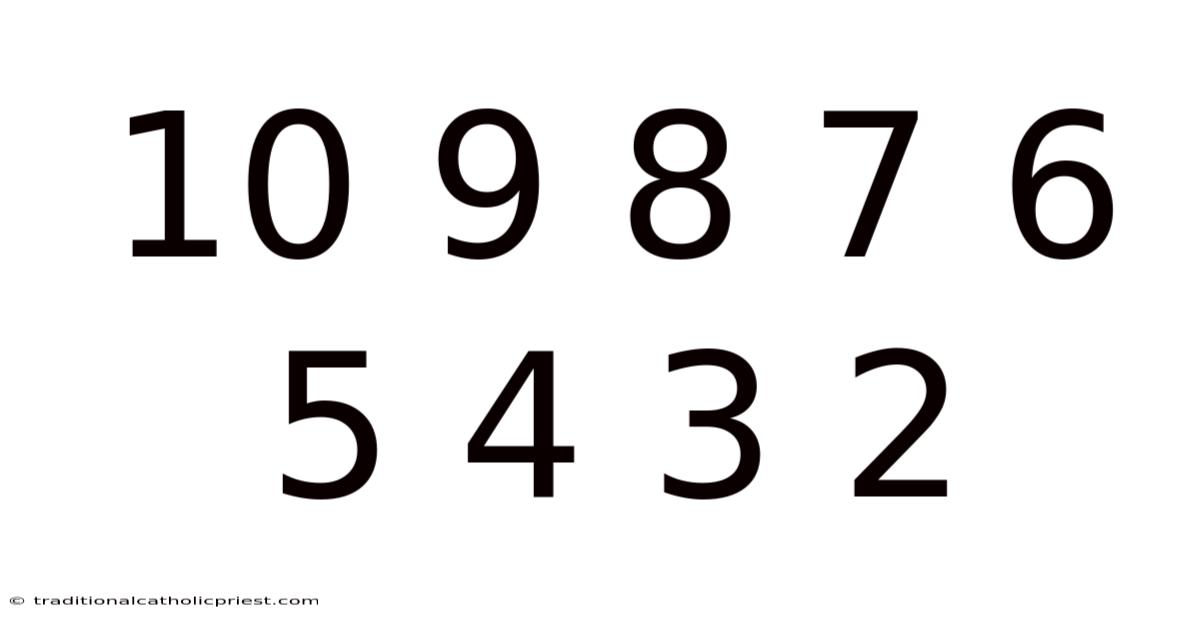
The countdown echoes in our minds – 10, 9, 8… the anticipation building with each descending number. In real terms, whether it’s the final seconds before a rocket launch, the exhilarating moment before the ball drops on New Year's Eve, or the intense pressure cooker of a timed exam, this numerical sequence encapsulates the essence of suspense and impending action. But beyond the fleeting moments of high drama, the sequence 10, 9, 8, 7, 6, 5, 4, 3, 2, and its implicit conclusion of 1, 0 – or blastoff – permeates various facets of our lives, symbolizing progress, milestones, and the inevitable march of time Small thing, real impact. Simple as that..
Easier said than done, but still worth knowing Most people skip this — try not to..
From education and technology to psychology and personal development, the countdown sequence holds a unique power. Understanding the multifaceted impact of this simple yet profound sequence offers valuable insights into how we organize our thoughts, manage our time, and ultimately, approach the goals we set for ourselves. It serves as a motivational tool, a structural framework, and even a cognitive aid. On top of that, consider the software development lifecycle, often structured in phases that mirror a countdown, or the psychological techniques that use the anticipation built through sequential counting to help overcome procrastination. Let's explore the pervasive influence and surprising versatility of the countdown from 10 to 2 It's one of those things that adds up. That's the whole idea..
The Ubiquitous Countdown: A Comprehensive Overview
The countdown sequence, in its simplest form, is a reverse numerical progression. While it might seem like a straightforward concept, its applications and implications are far-reaching. To fully appreciate its significance, let’s walk through its definitions, historical roots, and fundamental principles.
Defining the Countdown: At its core, a countdown is a sequence of numbers decreasing in order, typically from a specific starting point to zero or one. This sequence provides a structured timeframe, creating a sense of urgency and anticipation as it progresses. The most common example is the 10-to-zero countdown, widely popularized by NASA's space missions. Even so, countdowns can begin from any number and proceed with varying intervals, depending on the context.
Historical Roots: The use of countdowns can be traced back to various ancient practices. Consider timekeeping methods like hourglasses and water clocks, which, while not explicitly numerical, represented the passage of time towards a specific endpoint. Still, the modern concept of the numerical countdown gained prominence in the mid-20th century, largely thanks to the burgeoning space race.
During World War II, countdowns were employed in military operations to synchronize actions and ensure precision. On the flip side, it was NASA's use of countdowns in their space missions that truly cemented its place in popular culture. The launch of the first atomic bomb, for instance, involved a meticulously planned countdown sequence. The televised spectacle of rockets launching after a dramatic countdown captivated audiences worldwide, turning the sequence into a symbol of technological advancement and human ambition.
Scientific and Psychological Foundations: The power of the countdown isn't just cultural; it also has roots in psychology and cognitive science. Our brains are wired to recognize patterns and respond to anticipation. A countdown leverages these innate tendencies by creating a clear, predictable sequence that signals an imminent event.
- Anticipation and Arousal: Each descending number heightens anticipation, leading to increased physiological arousal. This heightened state of alertness can improve focus and performance, making countdowns effective tools in high-pressure situations.
- Time Perception: Countdowns influence our perception of time. By breaking down a larger timeframe into smaller, discrete units, they make time feel more manageable and less overwhelming. This is why countdowns are often used to structure tasks and break down large projects into smaller, more achievable steps.
- Cognitive Structuring: Countdowns provide a clear cognitive structure. They help us organize our thoughts and actions by establishing a defined beginning, middle, and end. This structure is particularly useful in complex situations where clear direction is essential.
- Motivational Impact: The ticking clock effect of a countdown serves as a powerful motivator. Knowing that time is running out encourages us to take action and avoid procrastination. This is why countdown timers are frequently used in productivity apps and time management techniques.
- Classical Conditioning: Through repeated association with exciting or important events, countdowns can become conditioned stimuli. Basically, the sound of a countdown alone can trigger a sense of excitement or urgency, even in the absence of the actual event.
The effectiveness of a countdown also depends on the individual and the context. Now, factors like personality, prior experiences, and the perceived importance of the event can all influence how a person responds to a countdown sequence. Even so, the underlying psychological principles remain consistent: countdowns tap into our innate tendencies to recognize patterns, respond to anticipation, and seek structure.
The sequence from 10 to 2 represents more than just a numerical progression; it's a distillation of anticipation, precision, and the relentless march of time. Its influence extends far beyond the launchpad, shaping how we approach tasks, manage our time, and strive towards our goals.
Trends and Latest Developments
The applications of countdowns are continually evolving, adapting to new technologies and shifting societal trends. From the rise of gamification to the increasing focus on mindfulness, countdowns are finding innovative uses in diverse fields. Here are some of the latest developments:
-
Gamification and Productivity: Countdown timers are increasingly integrated into gamified productivity apps. These apps use countdowns to break down tasks into manageable chunks, reward users for completing tasks within the allotted time, and track progress. The combination of gamification and countdowns can significantly boost motivation and engagement, making work feel less like a chore and more like a game Small thing, real impact..
- Expert Insight: The key to effective gamification is to strike a balance between challenge and reward. Countdowns should be challenging enough to create a sense of urgency, but not so difficult that they lead to frustration.
-
Mindfulness and Meditation: Counterintuitively, countdowns are also being used in mindfulness and meditation practices. In this context, the countdown serves as a tool for focusing attention and anchoring oneself in the present moment. By counting down from 10 to 1, individuals can quiet their minds, reduce anxiety, and cultivate a sense of inner calm.
- Expert Insight: The use of countdowns in mindfulness is about creating a structured framework for attention, not about rushing or achieving a goal. The focus should be on the process of counting, not on reaching zero.
-
E-commerce and Marketing: Online retailers frequently use countdown timers to create a sense of urgency and encourage purchases. Limited-time offers, flash sales, and expiring discounts are often accompanied by countdown timers that visually represent the dwindling time remaining. This tactic leverages the psychological principle of scarcity, prompting customers to make quick decisions and avoid missing out on a deal Still holds up..
- Expert Insight: The effectiveness of countdown timers in e-commerce depends on authenticity. If customers perceive the countdown as fake or manipulative, it can backfire and damage trust. Transparency and genuine scarcity are essential.
-
Education and Training: Countdowns are valuable tools in educational settings for structuring activities and managing time. Teachers use countdown timers to signal transitions between activities, allocate time for group work, and administer exams. The visual representation of time remaining helps students stay focused and manage their time effectively Still holds up..
- Expert Insight: When using countdowns in education, don't forget to provide clear instructions and expectations. Students should understand the purpose of the countdown and how it relates to the task at hand.
-
Accessibility and Inclusivity: Developers are increasingly mindful of accessibility when implementing countdown timers. This includes providing alternative formats for conveying time information, such as auditory cues or text-based countdowns. Ensuring that countdowns are accessible to individuals with disabilities is crucial for creating inclusive user experiences.
- Expert Insight: Accessibility should be considered from the outset of the design process. This includes conducting usability testing with individuals with disabilities to identify potential barriers and check that countdowns are usable by everyone.
-
Virtual and Augmented Reality: Countdowns are finding new applications in virtual and augmented reality (VR/AR) environments. They can be used to create immersive experiences, guide users through interactive simulations, and provide feedback on performance. The visual and auditory cues of a countdown can enhance the sense of presence and engagement in VR/AR environments.
- Expert Insight: The design of countdowns in VR/AR should be carefully considered to avoid causing motion sickness or disorientation. The visual elements should be clear, concise, and integrated easily into the environment.
-
Personal Development and Goal Setting: Individuals are using countdowns to track progress toward personal goals, such as weight loss, fitness milestones, or financial targets. By setting a specific timeframe and visualizing the countdown, they can stay motivated and accountable. Countdown apps and websites provide tools for tracking progress and celebrating achievements Worth keeping that in mind..
- Expert Insight: The key to successful goal setting is to break down large goals into smaller, more manageable steps. Countdowns can be used to track progress toward each step, providing a sense of accomplishment along the way.
These trends highlight the versatility and adaptability of the countdown sequence. As technology continues to evolve and our understanding of human behavior deepens, we can expect to see even more innovative applications of countdowns in the years to come Surprisingly effective..
Tips and Expert Advice
Harnessing the power of a countdown effectively requires careful consideration and strategic implementation. Here's some practical advice from experts across various fields:
-
Define Clear Objectives: Before implementing a countdown, clearly define the objectives you want to achieve. Are you trying to increase productivity, encourage purchases, reduce anxiety, or simply manage time more effectively? The specific goals will influence the design and implementation of the countdown Worth knowing..
- Example: If your goal is to increase productivity, break down a large task into smaller, time-boxed intervals using a countdown timer. Set realistic deadlines for each interval and reward yourself for completing them on time.
- Why it Works: Clear objectives provide a framework for measuring success and making adjustments as needed. Without a clear goal, a countdown can become a distraction rather than a motivator.
-
Choose the Right Starting Point and Interval: The starting point and interval of the countdown should be appropriate for the task at hand. A countdown that is too long can lose its sense of urgency, while a countdown that is too short can create unnecessary stress.
- Example: For a short task, such as answering emails, a 10-minute countdown might be appropriate. For a longer task, such as writing a report, a 60-minute countdown with short breaks in between might be more effective.
- Why it Works: Choosing the right starting point and interval ensures that the countdown aligns with the task's complexity and the individual's attention span. Experiment with different settings to find what works best.
-
Use Visual and Auditory Cues: Enhance the impact of the countdown with visual and auditory cues. A progress bar, a ticking clock sound, or a flashing screen can amplify the sense of urgency and keep you focused on the task.
- Example: Many productivity apps offer customizable countdown timers with various visual and auditory cues. Experiment with different options to find what resonates with you.
- Why it Works: Visual and auditory cues engage multiple senses, making the countdown more salient and memorable. They also provide immediate feedback on progress, which can be motivating.
-
Avoid Overuse: While countdowns can be effective, overuse can diminish their impact. Avoid using countdowns for every task or situation, as this can lead to fatigue and desensitization.
- Example: Reserve countdowns for tasks that require intense focus or have a specific deadline. For routine tasks, consider using other time management techniques.
- Why it Works: Strategic use of countdowns preserves their novelty and impact. By using them selectively, you can see to it that they remain effective motivators.
-
Personalize the Experience: Customize the countdown to match your individual preferences and learning style. Some people prefer visual countdowns, while others prefer auditory countdowns. Experiment with different options to find what works best for you But it adds up..
- Example: Many productivity apps allow you to customize the appearance and sound of the countdown timer. You can also choose to display the countdown in different formats, such as a pie chart or a progress bar.
- Why it Works: Personalization increases engagement and makes the countdown more relevant to your individual needs. By tailoring the experience to your preferences, you can maximize its effectiveness.
-
Be Mindful of Stress: Countdowns can create stress, especially if you are prone to anxiety. Be mindful of your stress levels and take breaks when needed. If you find that countdowns are consistently causing you stress, consider alternative time management techniques And it works..
- Example: If you start to feel overwhelmed by a countdown, take a short break to stretch, breathe deeply, or listen to calming music. You can also try reducing the duration of the countdown or breaking the task into smaller steps.
- Why it Works: Managing stress is crucial for maintaining productivity and well-being. If a countdown is causing you undue stress, you'll want to adjust your approach or find alternative strategies.
-
Use Countdowns for Positive Reinforcement: Countdowns can be used to create a sense of anticipation and excitement for positive events. This can be particularly effective for motivating yourself to complete challenging tasks.
- Example: Set a countdown for the end of a work week or the start of a vacation. Knowing that a positive event is approaching can make it easier to stay focused and motivated.
- Why it Works: Positive reinforcement is a powerful motivator. By associating countdowns with positive events, you can create a positive feedback loop that encourages you to stay on track.
By following these tips and incorporating expert advice, you can harness the power of countdowns to achieve your goals, manage your time more effectively, and enhance your overall well-being Turns out it matters..
FAQ
Q: Why are countdowns so effective?
A: Countdowns are effective because they tap into our innate psychological tendencies. They create anticipation, provide structure, and motivate us to take action by highlighting the scarcity of time That's the part that actually makes a difference..
Q: Can countdowns be harmful?
A: Yes, if used excessively or without proper consideration, countdowns can create stress and anxiety. make sure to be mindful of your stress levels and adjust your approach as needed The details matter here. That alone is useful..
Q: Are countdowns only useful for work-related tasks?
A: No, countdowns can be used in various contexts, including personal development, mindfulness, education, and even leisure activities.
Q: What's the best way to implement a countdown timer?
A: The best way to implement a countdown timer depends on the specific task and your individual preferences. Experiment with different settings, visual cues, and auditory cues to find what works best for you And that's really what it comes down to. That's the whole idea..
Q: Can I use a countdown for meditation?
A: Yes, countdowns can be used in meditation to focus attention and anchor yourself in the present moment. The focus should be on the process of counting, not on reaching zero.
Q: How can I make countdowns more accessible?
A: check that countdowns are accessible by providing alternative formats for conveying time information, such as auditory cues or text-based countdowns. Consider the needs of individuals with disabilities when designing countdown timers.
Q: Are countdowns only effective for short-term goals?
A: No, countdowns can be used to track progress toward both short-term and long-term goals. For long-term goals, break them down into smaller, more manageable steps and use countdowns to track progress toward each step And that's really what it comes down to..
Conclusion
The numerical sequence of 10, 9, 8, 7, 6, 5, 4, 3, 2 is far more than a simple countdown. It represents a powerful tool that can be leveraged for increased productivity, better time management, and even enhanced mindfulness. By understanding the psychological principles behind countdowns and implementing them strategically, we can reach their potential to achieve our goals and improve our overall well-being.
Ready to take control of your time and boost your productivity? Download a productivity app with customizable countdown timers, set a goal, and track your progress. That's why start experimenting with countdowns today! Share your experiences in the comments below and let us know how countdowns have helped you achieve your goals The details matter here..
