Imagine stepping into a world where numbers aren't just symbols on a page but keys to unlocking the very essence of existence. But beyond their practical applications, numbers hold a deeper, more mysterious allure. Numbers have fascinated humanity for millennia, serving as tools for counting, measuring, and defining our reality. They appear in patterns in nature, resonate within the harmonies of music, and underpin the complex algorithms that drive our technological age. The journey of understanding numbers is a journey into the heart of knowledge itself.
Exploring the realm of numbers requires us to dig into both the concrete and the abstract. On one hand, numbers are the bedrock of mathematics, a precise language used to describe the physical world. Looking at it differently, they are the subject of philosophical contemplation, imbued with cultural and symbolic meanings that shape our understanding of the universe. This exploration involves examining how numbers evolved from simple counting tools to complex systems that govern everything from quantum physics to financial markets.
Not obvious, but once you see it — you'll see it everywhere.
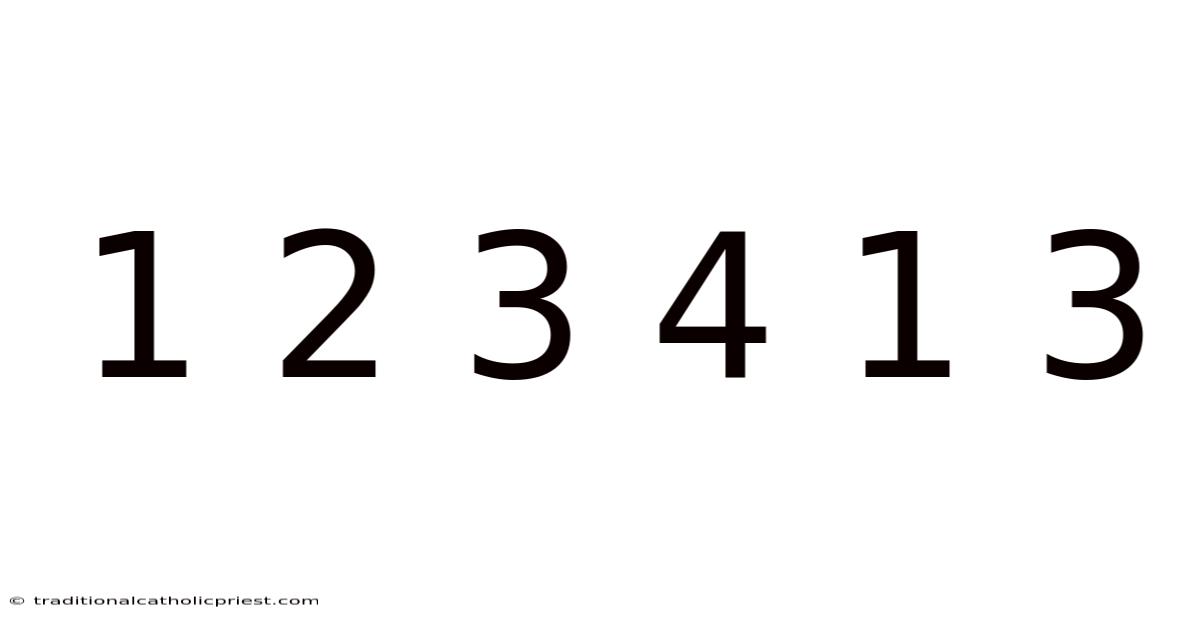
The Core Numerical Sequence: 1, 2, 3, 4, 1, 3
At first glance, the sequence "1, 2, 3, 4, 1, 3" may appear random or arbitrary. Still, within this seemingly simple sequence lies a wealth of mathematical, cultural, and symbolic potential. To truly understand its significance, we need to examine each number individually and then consider the sequence as a whole. This involves looking at their historical context, mathematical properties, and their presence in various fields ranging from music to computer science And it works..
The sequence begins with the fundamental building blocks of mathematics: 1, 2, 3, and 4. Each of these numbers holds unique properties and significance that have been recognized across cultures and throughout history. By understanding these individual numbers and their relationships, we can begin to appreciate the deeper structure and meaning embedded within this particular sequence. Let's explore each element in detail, uncovering the essence of "1, 2, 3, 4, 1, 3.
Understanding the Individual Numbers
-
One (1):
- Mathematical Significance: One is the foundation of all numbers. It is the multiplicative identity, meaning that any number multiplied by one remains unchanged. In set theory, it represents a single, indivisible entity.
- Cultural Significance: In many cultures, one symbolizes unity, beginnings, and the self. It represents the individual, the source of all things, and is often associated with leadership and independence. In monotheistic religions, one represents the singular God.
- Symbolic Representation: The number one often embodies concepts such as focus, determination, and initiation. It is seen as a powerful and assertive number, representing the start of a new cycle or venture.
-
Two (2):
- Mathematical Significance: Two represents duality, the first even number, and is the basis of the binary system, which is the foundation of modern computing. It signifies pairs and relationships.
- Cultural Significance: Two symbolizes balance, harmony, and partnership. It represents the concept of yin and yang in Chinese philosophy, the duality of male and female, and the idea of cooperation and interaction.
- Symbolic Representation: The number two embodies concepts such as diplomacy, cooperation, and balance. It is seen as a receptive and sensitive number, representing the need for partnership and understanding.
-
Three (3):
- Mathematical Significance: Three is the first odd prime number. It is significant in geometry, representing the minimum number of points needed to define a plane (a triangle).
- Cultural Significance: Three often symbolizes completeness, harmony, and the union of opposing forces. In many mythologies, it represents a triad of deities, such as the Father, Son, and Holy Spirit in Christianity. It also represents the past, present, and future.
- Symbolic Representation: The number three embodies concepts such as creativity, expression, and optimism. It is seen as a joyful and communicative number, representing the ability to bring ideas into reality.
-
Four (4):
- Mathematical Significance: Four is the first composite number (a number that can be divided evenly by numbers other than 1 and itself) and a perfect square. It represents stability and structure.
- Cultural Significance: Four often symbolizes stability, order, and completeness. It represents the four cardinal directions (North, South, East, West), the four seasons, and the four elements (earth, water, air, fire) in many traditions.
- Symbolic Representation: The number four embodies concepts such as practicality, discipline, and hard work. It is seen as a grounded and reliable number, representing the need for a solid foundation.
Analyzing the Sequence: 1, 2, 3, 4, 1, 3
Now that we have examined the individual numbers, let's analyze the sequence as a whole. The sequence "1, 2, 3, 4, 1, 3" can be interpreted in various ways depending on the context.
- Cyclical Patterns: The repetition of '1' suggests a cyclical pattern, emphasizing beginnings and restarts. The sequence could represent a process that returns to its initial state after a series of steps.
- Incomplete Progression: The sequence breaks the natural progression of numbers by omitting '2' and '4' in the second half. This disruption could symbolize a deviation from the norm, a unique path, or an unfinished process.
- Balanced Imbalance: The sequence contains both even and odd numbers, creating a sense of balance. Even so, the uneven distribution of numbers creates an imbalance, suggesting a dynamic and potentially unstable system.
- Potential for Encoding: The sequence could be a code or a key to unlocking a larger pattern. It could be used in cryptography, music composition, or even as a sequence of instructions in computer programming.
Applications and Interpretations
- Music Composition: The sequence could represent a series of notes or chords in a musical composition. Each number could correspond to a specific note in a scale or a chord progression. The repetition of '1' and the inclusion of '3' could create a memorable and unique melody.
- Computer Science: In computer programming, the sequence could represent a series of instructions or commands. Each number could correspond to a specific function or operation. The repetition of '1' and the omission of '2' and '4' could create a loop or a conditional statement.
- Art and Design: The sequence could be used as a basis for creating visual patterns or designs. Each number could correspond to a specific color, shape, or element. The repetition of '1' and the progression to '3' and '4' could create a dynamic and visually appealing composition.
- Project Management: The numbers can represent stages in a project's timeline. "1" could be the initiation, "2" planning, "3" execution, and "4" closure, with the sequence implying a restart at initiation before moving to refine the execution stage.
- Personal Growth: Individuals could use the sequence as a model for personal development. Focus on oneself (1), acknowledge relationships (2), embrace creativity (3), and build a stable life (4), repeating the focus on oneself before using creativity to refine their identity.
Trends and Latest Developments
Mathematical Trends
Modern mathematics is exploring numerical sequences with increasing sophistication, using computational tools to identify complex patterns and relationships. Number theory, in particular, is delving into the properties of prime numbers and their distribution, which has significant implications for cryptography and data security. The study of chaotic systems and fractals also relies heavily on numerical sequences to model complex phenomena And it works..
Some disagree here. Fair enough.
Cultural Trends
In popular culture, numbers continue to hold symbolic significance. Numerology, the study of the mystical properties of numbers, remains popular, with many people seeking guidance and insight from numerical patterns in their lives. The use of numbers in art, music, and literature continues to evolve, with artists exploring new ways to express numerical concepts and patterns Simple as that..
Technological Trends
Technology is driving new developments in the study and application of numerical sequences. So naturally, machine learning algorithms are being used to analyze vast amounts of data and identify patterns that would be impossible for humans to detect. The development of quantum computing promises to open up new possibilities for solving complex mathematical problems and simulating physical systems It's one of those things that adds up. No workaround needed..
Tips and Expert Advice
- Embrace Curiosity: Approach numerical sequences with a sense of wonder and curiosity. Don't be afraid to experiment and explore different interpretations. Consider the sequence "1, 2, 3, 4, 1, 3" as a puzzle to be solved, a mystery to be unraveled.
- Look for Patterns: Pay attention to the patterns and relationships within the sequence. Identify repetitions, omissions, and progressions. Ask yourself what these patterns might signify. To give you an idea, the repetition of '1' in the sequence could indicate a recurring theme or a cycle.
- Consider Context: Think about the context in which the sequence appears. What is the purpose or function of the sequence? How does it relate to the surrounding information or environment? Here's a good example: if the sequence appears in a musical composition, it could represent a series of notes or chords.
- Explore Different Interpretations: Be open to multiple interpretations. There is no single "correct" answer when it comes to understanding numerical sequences. Allow your imagination to run wild and consider different possibilities. The sequence "1, 2, 3, 4, 1, 3" could represent a journey, a process, or a set of instructions.
- Connect to Personal Experience: Relate the sequence to your own personal experiences and observations. How does the sequence resonate with your own life? What insights or lessons can you glean from it? The sequence could represent a personal challenge, a relationship, or a goal.
FAQ
- What is the significance of numerical sequences in mathematics?
- Numerical sequences are fundamental to many areas of mathematics, including number theory, calculus, and analysis. They are used to model patterns, solve equations, and explore complex systems.
- How are numerical sequences used in computer science?
- Numerical sequences are used extensively in computer programming, data analysis, and algorithm design. They are used to generate random numbers, encrypt data, and optimize performance.
- What is the role of numerical sequences in music?
- Numerical sequences can be used to create melodies, harmonies, and rhythms. They can be used to generate scales, chords, and rhythmic patterns. Many composers use numerical sequences to structure their compositions.
- Can numerical sequences be used for personal development?
- Yes, numerical sequences can be used as a framework for personal growth and self-reflection. They can provide insights into patterns, relationships, and cycles in one's life.
- Where can I learn more about numerical sequences?
- There are many resources available for learning about numerical sequences, including books, websites, and online courses. You can also consult with mathematicians, scientists, and artists who work with numerical sequences.
Conclusion
The sequence "1, 2, 3, 4, 1, 3" is a microcosm of the broader world of numbers, reflecting their fundamental importance, cultural significance, and potential for creative expression. On the flip side, this seemingly simple sequence embodies the cyclical nature of beginnings, the tension between balance and imbalance, and the potential for encoding deeper meanings. By understanding the individual numbers and their relationships, we can reach a deeper appreciation for the beauty and complexity of mathematics Took long enough..
As you continue your exploration of numbers, I encourage you to embrace curiosity, look for patterns, and consider the context in which numbers appear. Experiment with different interpretations, connect numbers to your personal experiences, and share your insights with others. To further your understanding, leave a comment below sharing how you interpret the sequence "1, 2, 3, 4, 1, 3" in your own life or field of study. This collaborative exchange will enrich our collective understanding and appreciation for the power of numbers.
